Article Sidebar
Overview
Headquartered in Salem, Oregon, with offices in Pittsburgh, Pennsylvania, and a new 60,000 square foot facility opening in Fremont, California, Agility Robotic, Inc.’s (“Agility”) mission is to build robot partners that augment the human workforce. Agility’s groundbreaking general-purpose humanoid robot, Digit, is a multi-purpose, human-centric robot that is made for work™.
Through domestic manufacturing, real-world commercial deployments, and validated safety pathways, Agility has moved humanoid robotics beyond hype videos and into operational environments. What is missing is not capability, but a focused federal policy framework to support, accelerate, and scale what is already working and what needs additional stimulation.
Agility proposes that the United States adopt a robotics policy that does two things simultaneously: (1) enables the safe, large-scale development and deployment of humanoid robots in the United States, and (2) reduces the cost and friction of adoption of humanoid robots across industry and government.
In this paper, Agility outlines six proposed federal policy pillars that can be advanced immediately to achieve that objective through nuanced industrial policy.
1. Stimulating U.S. Manufacturing & Robotics Supply Chain
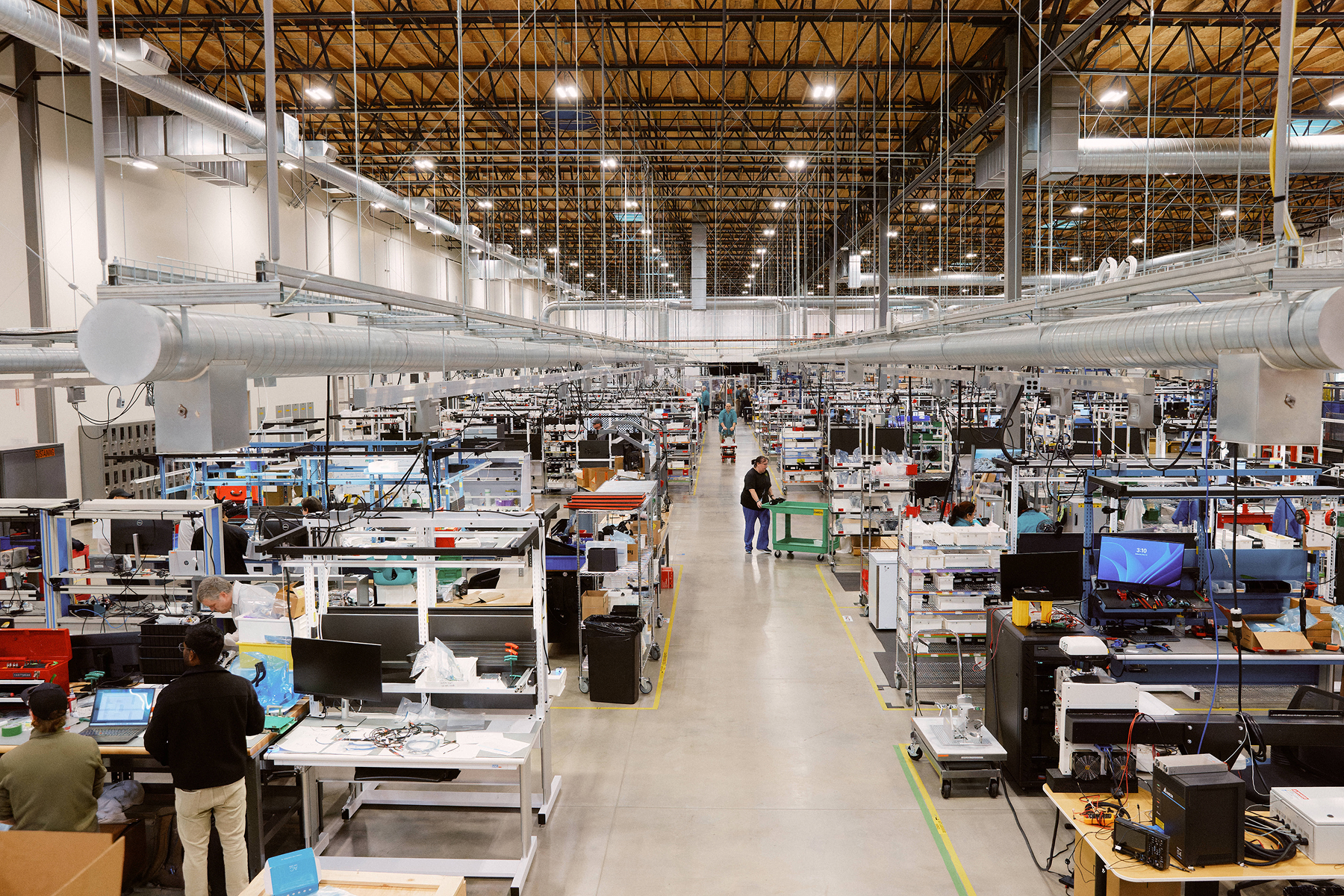
Agility domestically operates in (1) RoboFab, a dedicated humanoid robot manufacturing facility designed to scale production to over 10,000 units annually located in Salem, Oregon; (2) office and R&D space that is geographically in the core of the AI revolution located in Fremont, California; and (3) office and R&D space that provides Agility with direct access to pre-eminent robotists and universities in the robotics industry in Pittsburgh, Pennsylvania. Each of Agility’s facilities represents tangible examples of advanced domestic development, manufacturing, and assembly capacity in the robotics sector, currently employing 371 people with major growth on the horizon.1 Agility’s mutli-talented workforce includes highly skilled hardware and software engineers, as well as other technical and administrative talent that drives a positive economic impact throughout local communities and job markets.
Agility’s supply chain reflects the realities of today’s global industrial base. To manage costs, maintain performance expectations, and achieve safety standards required for commercial deployment, certain components in humanoid robots must be sourced internationally. With that said, Agility is continuously reviewing and evaluating opportunities to source domestically or through allied countries.
Enhanced federal policy focused on strengthening incentives for domestic robotics manufacturing and supply chain resilience programs will allow Agility to further source components domestically or from allied countries. Moreover, increased domestic capabilities that rise to meet the demand from domestic and/or allied sources will also enable Agility to choose domestic suppliers to manufacture components that are derived from its most highly sensitive intellectual property (as opposed to using foreign suppliers which creates an increased risk of intellectual property leakage). Further, special attention should be paid to domestic and friendshored component sourcing of rare earth materials and other essentials that underpin humanoid robotics production.
2. Strategic Competition with China
The global race in humanoid robotics is increasingly defined by competition with China, which has demonstrated rapid advancement in manufacturing and deployment. Agility’s Digit platform represents a U.S.-based alternative in this emerging strategic sector.2 In order to compete with the Chinese market, we need commitment from the government to dedicate resources to scale quickly and address this increasingly challenging market.
Federal policy should include the development of a national robotics strategy, leveraging trade tools such as tariffs and anti-dumping measures, and coordination with allies to ensure trusted supply chains and market access. Additionally, given the proliferation of Chinese humanoid robotics hitting the global market, incentives for an American humanoid robotics market needs to be front and center, as well as more stringent data security policies addressing the potential syphoning of U.S.-data abroad.
3. Safety, Standards, & Workplace Integration
Digit has received Occupational Safety and Health Administration-recognized Nationally Recognized Testing Laboratory approval, enabling expanded commercial deployment in logistics environments.3 4 We also welcome opportunities to collaborate with the National Institute of Standards and Technology and the National Telecommunications and Information Administration to benchmark the assessment of humanoid capabilities and other AI initiatives. 5 6
Federal policy should prioritize voluntary standards development at the federal level and industry bodies, rather than prescriptive regulation. This may include human-robot collaboration frameworks, workplace safety guidance, and other categorization efforts.
4. Workforce Augmentation & Labor Supply
Digit is deployed in logistics, manufacturing, and warehouse environments to perform repetitive and physically demanding tasks. Partnerships with GXO and Toyota Motor Manufacturing Canada demonstrate real-world applications that support workforce augmentation to meet workforce gaps particularly with respect to roles that have high occurrence of health risk implications.7 8 Federal policy should properly reward employers who are able to decrease safety incidents through the proper deployment of robotics and automation technology within the workplace.
Moreover, robot maintenance and manipulation open up new employment opportunities for properly trained technicians. Federal policy should support workforce development pipelines, including robotics technician training, apprenticeships, and partnerships with institutions of higher learning and technical trades to prepare the workforce in these growing industries.
5. Accelerating Commercial Deployment
Digit’s deployment with Agility’s customers, including moving over 100,000 totes in operational environments, demonstrates that humanoid robots are transitioning from pilot programs to scaled deployment.9 Agilty’s cloud automation platform, Arc, is designed to allow customers to deploy and manage a Digit fleet from facility mapping and workflow definition to operational management and troubleshooting.
The combination of Agility’s hardware and software solutions gives Agility better vertical integration for commercial deployment in a Robots-as-a-Service (RaaS) model which can integrate with the customer’s existing automation tools, including Autonomous Mobile Robots.
Real-world humanoid data collected via commercial deployment is also building a unique data lake that will drive advancement in Physical AI foundation models. Combined with simulation data, like what we leverage through NVIDIA Isaac SimTM, IsaacTM, and NVIDIA OmniverseTM, we are able to create breakthrough training methodology for new human and humanoid robotics workforce collaborations.10
Federal policy should support deployment through commercially viable early adopter programs, tax incentives for end-users, and other tools. Given the financial capital restraints that small and medium enterprises (SMEs) typically have, opening up opportunities through tailored tools for SMEs may be an ideal starting point, especially for market signals. All of these could feed into federal data sharing that would help spur commercialization efforts.
6. Federal Procurement, Defense & Dual-Use Applications
Humanoid robotics platforms like Digit have potential applications in logistics and supply chain operations relevant to federal civil agencies and defense environments. The Department of War has even outlined using “robotic capabilities in sustainment operations when the value proposition for automation results in increased productivity; improved quality, health, and safety; or reduced environmental impact.” 11
Federal policy should explore and quickly define procurement pathways for humanoid robotics, industrial base resilience initiatives, and dual-use applications that strengthen domestic capabilities without weaponization.
Endnotes
- Agility Robotics, “Opening RoboFab: World’s First Factory for Humanoid Robots,” Agility Robotics (2023), https://www.agilityrobotics.com/content/opening-robofab-worlds-first-factory-for-humanoid-robots (last visited May 1, 2026).
- Associated Press, “US robotics companies push for national strategy, including a central office, to compete with China,” AP News (2025), https://apnews.com/ (last visited May 1, 2026).
- Agility Robotics, “Beyond the Hype,” Agility Robotics (2024), https://www.agilityrobotics.com/content/beyond-the-hype (last visited May 1, 2026).
- Occupational Safety and Health Administration, “Robotics Standards,” U.S. Department of Labor, https://www.osha.gov/robotics/standards (last visited May 1, 2026).
- National Institute of Standards and Technology, “Humanoid Robot Baseline Performance Benchmark,” U.S. Department of Commerce (2026), https://www.nist.gov/el/intelligent-systems-division-73500/humanoid-robot-baseline-performance-benchmark (visited May 5, 2026).
- National Telecommunications and Information Administration (NTIA), “Artificial Intelligence,” U.S. Department of Commerce (2026), https://www.ntia.gov/programs-and-initiatives/artificial-intelligence (visited May 11, 2026).
- Agility Robotics, “GXO Signs Industry-First Multi-Year Agreement with Agility Robotics,” Agility Robotics (2023), https://www.agilityrobotics.com/content/gxo-signs-industry-first-multi-year-agreement-with-agility-robotics (last visited May 1, 2026).
- Agility Robotics, “Agility Robotics Announces Commercial Agreement with Toyota Motor Manufacturing Canada,” Agility Robotics (2024), https://www.agilityrobotics.com/content/agility-robotics-announces-commercial-agreement-with-toyota-motor-manufacturing-canada (last visited May 1, 2026).
- Agility Robotics, “Digit Moves Over 100K Totes,” Agility Robotics (2024), https://www.agilityrobotics.com/content/digit-moves-over-100k-totes (last visited May 1, 2026).
- NVIDIA, “Humanoid Robot ‘Digit’ Powered by Whole-Body Control Foundation Model,” NVIDA (2025), https://www.nvidia.com/en-us/case-studies/agility-robotics-digit-humanoid-robot/ (last visited May 5, 2026).
- U.S. Department of War, Directive 5000.94, “DoD Robotics and Autonomous Systems” (2023), https://www.esd.whs.mil/Portals/54/Documents/DD/issuances/dodi/500094p.PDF (last visited May 1, 2026).