Article Sidebar
AI Will Have its Biggest Influence Through Human-Centric Robots
As humanoids enter the public sphere, forecasters are trying to predict where the technology will go - with some suggesting that hardware will become a commodity, leading to largely software-defined general-purpose machines. But this goes too far. AI is just software trapped behind the physics of the hardware it’s running on. Existing industrial robotic automation solutions are better than humans at achieving high-precision position trajectories, and thus better at machining metal, spot welding or high-speed pick-and-place operations. However, humans remain much better at going over any sort of terrain, mobile manipulation, assembly tasks, and other things that require a soft, force-based approach to physical interaction. AI alone, or any software, won’t bridge the gap between these two sets of capabilities.
Hardware Dynamics Drive What is Physically Possible
It’s very easy to make a robot that looks like a human, but much more difficult to make a robot that moves like a human, especially when it makes contact with the physical world. Although we can observe the form and position of a person or robot, we don’t have a complete understanding of how humans achieve such capable manipulation and locomotion, and thus we cannot yet recreate it. Even a robot that looks convincingly like a person may have very different dynamics, such as joint friction, inertia, or compliance. And those hardware dynamics are the only path through which any control approach, AI or otherwise, can act on the world. They are more important than the form of the robot and can either be a barrier to control or an essential partner, depending on their properties.
A human motion is more than a series of positions, it’s also an entire set of dynamics that will respond in particular ways when encountering the environment. It’s possible to generate trajectories for the robot to follow that look extremely convincing until some disturbance, like an unexpected step down, shows major performance and visual differences between the motions of the robot and a person. How can we make robot arms that swing freely for balance during locomotion, whose motion is determined by the pendular swing of their mass and near-passive joints, while still being able to apply large forces to lift heavy things? How can we place a foot gently while walking on uneven terrain, repeatedly making contact that is never perfectly anticipated? And how can we make fingers with the compliance, strength, and force sensitivity for dexterous manipulation?
Predictions on the Best Hardware Path
Human-centric robots will be bipedal, with an upright torso, and bimanual. They will have human-robot interaction features like a face. But that is where similarities will end: there is no reason for human-centric machines to look just like us. In the future, looking back on some of today’s humanoid robots with precise human dimensions or five-fingered hands will be akin to looking back at early heavier-than-air flying machine prototypes. Some had flapping wings and other bird-like biomimetic features, because we didn’t yet understand the physics of flying, just as the physics of locomanipulation are presently in their early days. But once the industry understands the physics of locomanipulation well and the softer science of human-robot interaction, we will see a proliferation of human-centric machines with familiar features, but clear differences – just as we see a proliferation of aircraft that still have wings (but not feathers).
The basic humanoid form comes from first principles. Dynamic stability (balance) is important for operating in small spaces like hallways while reaching up high; and legs can be far more stable than wheels, because the feet can more quickly move to new locations to support the center of mass when there’s a disturbance. An upright torso further enables the narrow footprint, while allowing space for computation, batteries, and improving the ability to balance by leaning in the direction of acceleration. A pair of arms mounted at the highest points on the torso (the shoulder locations) enables a good workspace for lifting large objects from the ground to the highest possible shelf, a good workspace for catching a fall, and excellent inertial actuation for turning or balance.
Primary actuators will be electromagnetic, a refinement and evolution of the brushless linear DC motors we see now, and will achieve much higher torque for a given motor mass than today’s motors. We will see new motor forms that improve manufacturability along with torque density through new configurations like the YASA axial flux motors [1] being used in cars now, transverse flux variants, or just refinements of a standard radial flux motor that are enabled by new 3D electromagnetic modeling methods, new high-flux magnetically soft materials, and new manufacturing approaches. Even with higher torque density in motors, a transmission will always be necessary, especially for larger robots, because scaling laws mean that larger machines are proportionally weaker than smaller machines (ants can lift many times their weight, but elephants can’t jump). New classes and types of actuator, such as polymer muscles, are still far away, and pneumatic or hydraulic actuators have fundamental flaws for energy efficiency and performance in a humanoid application.
The transmission of choice for large joints (knee, elbow, etc.) will be rolling-contact cycloids. They offer an unmatched combination of low friction, high durability, wear characteristics even with regular impacts, compact form factor, torque density for their mass, and manufacturability without exotic methods. They can be integrated well with electromagnetic actuators into a convenient module to be used at robot joints. In combination with the high torque density of new motors, nothing will match their high-bandwidth torque control and backdriveability.
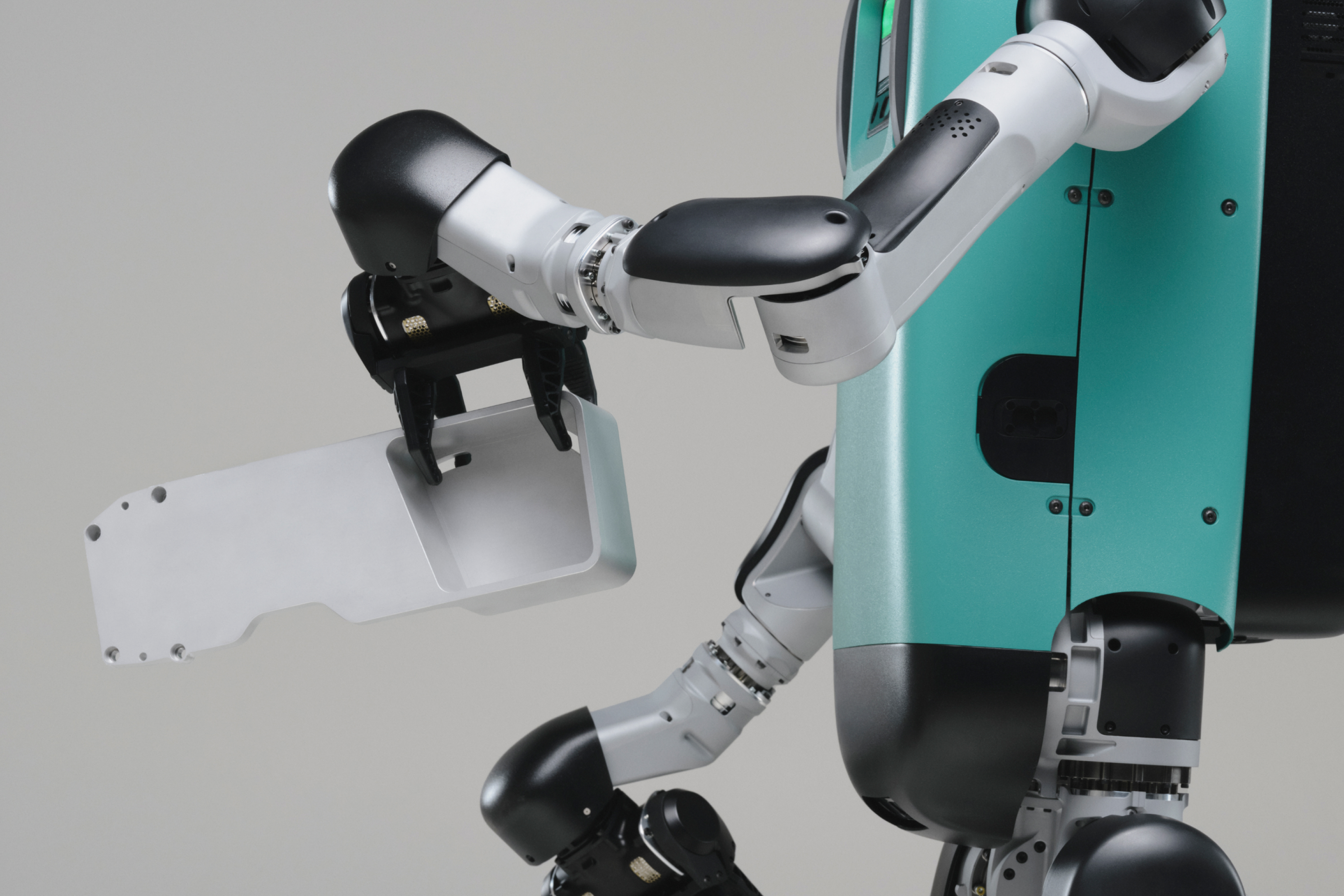
Hands and fingers will be tendon-driven, using series elastic actuators. Tendons, combined with links that are only in compression loading in a tensegrity-style approach, are the most structurally efficient way to apply large forces at the end of thin digits [2]. Actuators will be in the forearm, as muscles that power human hands are, because of the high power and force needed. Given the extreme compactness and forces needed from hand actuators, even when moved to the forearm, speed reductions will be high and they will not be directly backdriveable as the large-joint cycloids can be. However, we will need exceptional force control as well as impact tolerance in the fingers; thus, series elasticity will be required [3]. Finally, tendons are not durable. They will be replaceable wear components, like the soles of the feet.
Walking will require a functional heel strike to absorb the impact of foot contact and transition from leg swing to a firm stance [4]. To power the gait for efficient, faster walking, a toe-off will also be required. This is because a humanoid will have a near-straight knee most of the time so it will not be using excessive energy to support its weight. The heel strike allows the knee to begin bending and absorb the rest of impact, and the toe-off extends the leg beyond the straight-knee configuration to add energy with each stride. There will be structure in the foot to handle this well, beyond the flat metal plates we see today.
Looking Forward
Humanoids are beginning to provide utility today in commercial and industrial environments, doing work that has been designed for humans, in spaces designed for humans. These first robot tasks are still process-automated: more variable than typical robot tasks and thus humans still do them, but still meet the classic three “D’s” of robotics, being Dull, Dirty, or Dangerous, like moving totes around, sorting packages, or simple kitting processes. As humanoids gain increasing capability and generality, and become safe and benefit from an increasingly detailed regulatory framework, and as they come down in price, they will expand into many more commercial and industrial settings, including familiar retail environments. They will move gradually from the back room to more public spaces as certifiably safe operation is addressed. Safety, of course, relies on perception and context-aware intelligent choices - but also on actuators that can reliably (a safety-certified, redundant level of reliably) apply safe forces in safe locations when they physically interact with people, avoiding pinch points, falling on someone’s foot, and other physical risks [5, 6]. Only after robot locomotion and manipulation have achieved broadly general capabilities in environments as varied as people’s homes, and have scaled to the point where the cost is affordable to families, and have gradually improved and proven their safe operation to the point where we can trust them around our children and pets, will they begin to enter homes and become part of everyday life for most people.
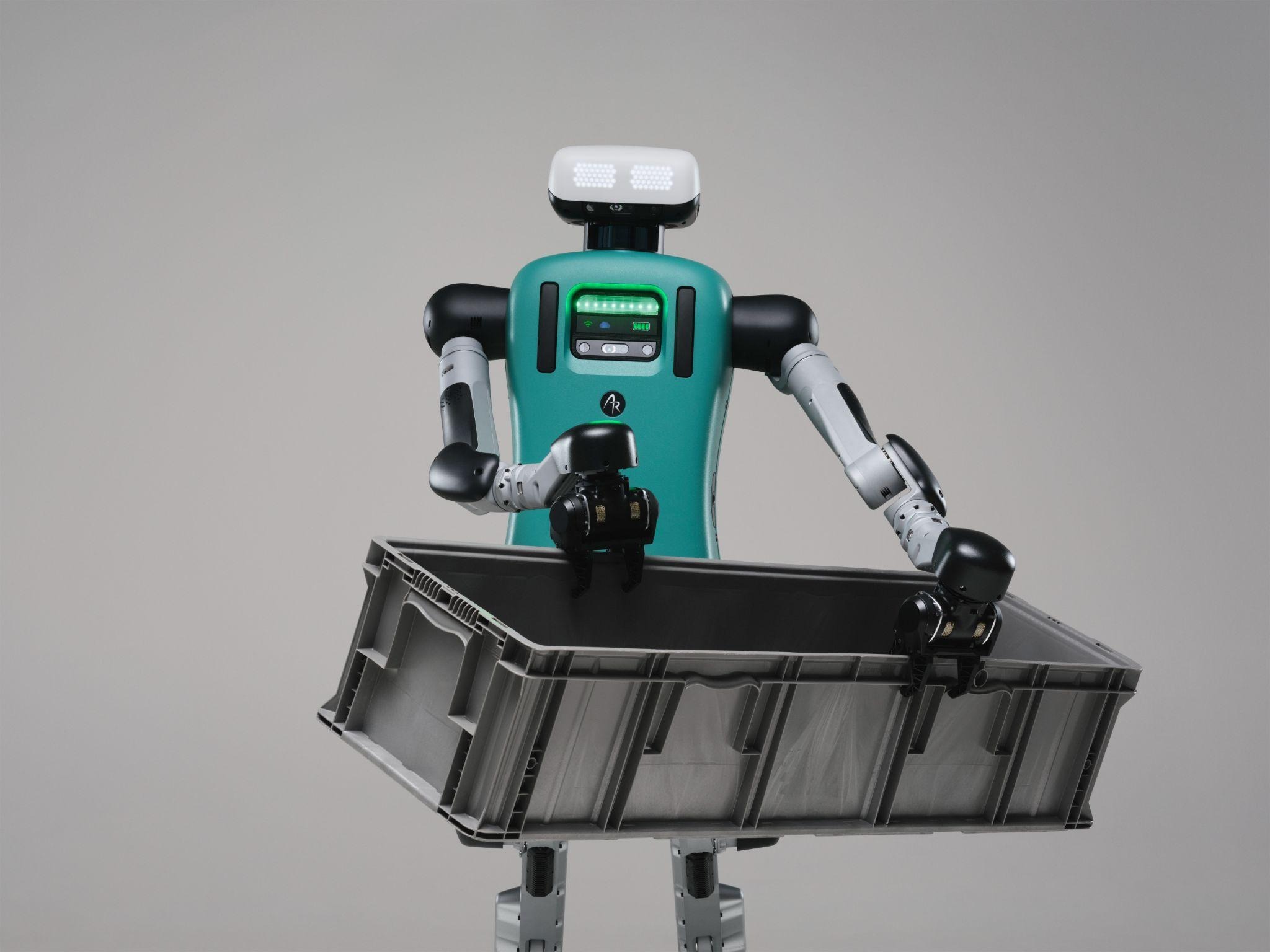
Humanoids, enabled by AI, bring a new era of robotics: unlocking operations wherever people work without requiring architectural modifications. And multi-purpose robots will address a variety of tasks that could not be automated easily with single-purpose machinery. These two features - operating in human spaces, and being multi-purpose - are going to redefine labor, and amplify human ambition in a way that will be analogous to an accelerated industrial revolution. There will be an array of humanoid robots as varied as vehicles on the road, with their own specialties and features. Humans will soon have robot helpers in a way that humanity has never experienced before.
Endnotes
- T. J. Woolmer and M. D. McCulloch, "Analysis of the Yokeless And Segmented Armature Machine," 2007 IEEE International Electric Machines & Drives Conference, Antalya, Turkey, 2007, pp. 704-708, doi: 10.1109/IEMDC.2007.382753.
- “Continuous Tension, Discontinuous Compression, A Model for Biomechanical Support of the Body,” S. M. Levin, Bulletin of Structural Integration 8, 29–34 (1982)
- G. Pratt, M. Williamson, Series elastic actuators, ‘Human Robot Interaction and Cooperative Robots’, IEEE/RSJ International Conference on Intelligent Robots and Systems, volume 1, pages 399 –406 vol.1 (1995).
- J.J. Rond, M.C. Cardani, M.I. Campbell, J.W. Hurst, Mitigating peak impact forces by customizing the passive foot dynamics of legged robots. Journal of Mechanisms and Robotics, 12(5). (2020).
- Prather, A. (2025). A pathway study for future humanoid standards. IEEE Humanoid Study Group. https://www.therobotreport.com/wp-content/uploads/2025/09/IEEE-Humanoid-Report-of-Future-Standards-Development.pdf
- De Santis, A., Siciliano, B., De Luca, A., & Bicchi, A. (2008). An atlas of physical human–robot interaction. Mechanism and Machine Theory, 43(3), 253–270. https://doi.org/10.1016/j.mechmachtheory.2007.03.003
Acknowledgements
Thank you to Dan Collins, Jay Jasper and Andy Abate for important fact-checking, editing, suggestions, and other support for this article.
Competing Interests
The author works at Agility Robotics and has equity interest in the company, which produces the Digit humanoid robot.
Read the definitive version: Jonathan Hurst, "Physical AI is enabled by mechanical hardware," Science Robotics 11, eaee2921 (2026). https://www.science.org/doi/10.1126/scirobotics.aee2921
This is the author's version of the work. It is posted here by permission of the AAAS for personal use, not for redistribution. The definitive version was published in Science Robotics on August 12, 2026; doi: 10.1126/scirobotics.aee2921.